
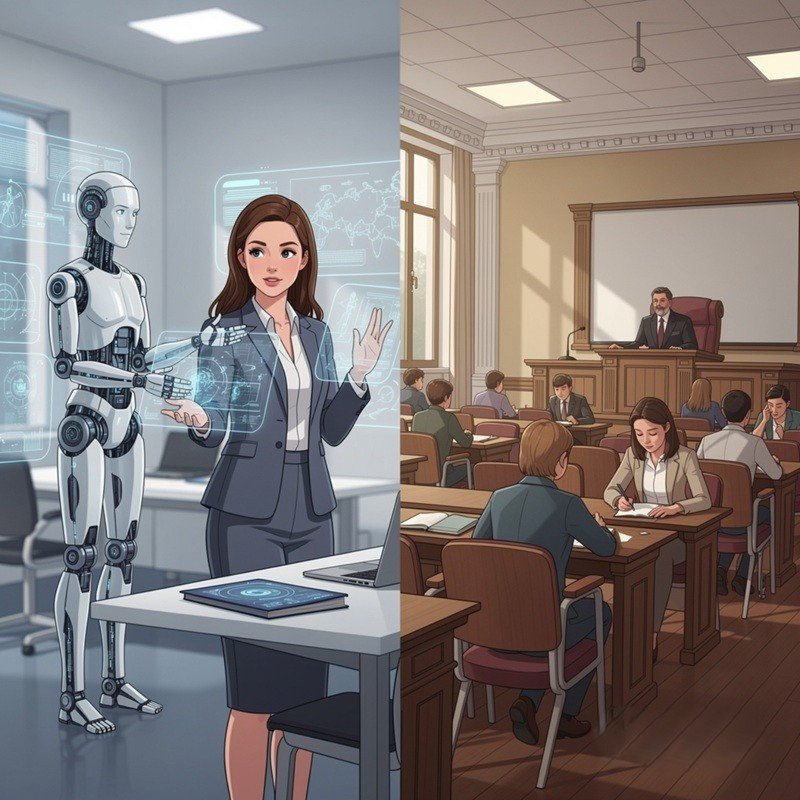
Not long ago, artificial intelligence was mostly a topic discussed in computer science departments and science fiction novels. Today, it has become part of everyday life. Students use AI to summarize research papers, explain difficult concepts, generate study plans, and even practice for job interviews. Professors are redesigning assignments because of it, employers are changing hiring expectations, and universities around the world are racing to adapt.
With AI becoming increasingly capable, an inevitable question has emerged: Will artificial intelligence eventually replace traditional college education?
It’s a compelling idea. If an AI tutor can explain calculus in seconds, generate personalized quizzes, and answer questions at any hour of the day, why spend years sitting in lecture halls?
The reality, however, is far more nuanced.
Artificial intelligence is poised to transform higher education in profound ways, but replacing universities entirely is a much bigger challenge than replacing textbooks or lectures. To understand why, it’s important to first recognize what colleges actually provide—and what AI can and cannot do.
College Has Never Been Just About Information
For much of history, universities served as the primary gateway to knowledge. Professors possessed expertise that students couldn’t easily access elsewhere, and lectures were often the most efficient way to distribute information.
Today, that monopoly no longer exists.
A student can learn programming, economics, psychology, or marketing through online courses, educational videos, digital libraries, and AI-powered assistants. Information has become abundant, inexpensive, and available around the clock.
This shift changes the role of higher education.
Modern universities increasingly offer something beyond information:
- Structured learning pathways
- Academic mentorship
- Research opportunities
- Professional networking
- Access to laboratories and specialized equipment
- Collaborative projects
- Recognized credentials
These experiences are far more difficult to replace than a lecture.
AI Is Already Changing How Students Learn
Whether universities encourage it or not, students have already integrated AI into their daily academic routines.
Instead of spending hours searching for introductory explanations, many now ask AI to:
- Simplify complex concepts
- Generate study guides
- Explain formulas step by step
- Translate academic language into plain English
- Create practice quizzes
- Brainstorm essay ideas
This doesn’t necessarily reduce learning.
Used responsibly, AI often allows students to spend less time struggling with basic explanations and more time understanding deeper concepts.
In many ways, artificial intelligence resembles a highly personalized tutor that never sleeps.
Personalized Learning Could Become the New Standard
One limitation of traditional classrooms is that every student learns differently.
Some grasp concepts immediately.
Others need repetition, alternative explanations, or additional examples.
A professor teaching hundreds of students rarely has time to personalize every lesson.
Artificial intelligence changes that equation.
An AI learning assistant can:
- Adapt explanations to different learning styles
- Increase or decrease difficulty automatically
- Identify weak areas
- Recommend additional practice
- Provide instant feedback
Instead of forcing every student through the same pace, AI can create individualized learning experiences.
For many educators, this represents one of AI’s greatest strengths—not replacing teachers, but making education more adaptive.
What AI Does Better Than Traditional Lectures
Artificial intelligence excels at tasks that involve speed, repetition, and personalization.
For example, AI can:
- Answer routine questions instantly
- Generate unlimited practice problems
- Provide immediate feedback
- Summarize lengthy readings
- Translate educational content into multiple languages
- Create customized revision plans
Unlike a classroom lecture, AI adjusts to the individual rather than expecting the individual to adjust to the lesson.
For independent learners, this flexibility is incredibly valuable.
But Education Is More Than Learning Facts
One of the biggest misconceptions in the AI debate is assuming that college exists simply to transfer knowledge.
Knowledge is only one piece of higher education.
Universities also teach students how to:
- Think critically
- Evaluate evidence
- Conduct original research
- Collaborate with diverse teams
- Communicate ideas effectively
- Solve ambiguous problems
- Defend arguments under scrutiny
These skills develop through interaction, discussion, experimentation, and experience.
An AI can help students practice them, but it cannot fully recreate the dynamic environment of a university community.
The Campus Experience Still Matters
Ask graduates what they remember most about college, and lectures rarely top the list.
Instead, they often mention:
- Friendships
- Student organizations
- Research projects
- Internships
- Mentors
- Networking opportunities
- Campus events
These experiences shape careers and personal growth in ways that are difficult to replicate digitally.
Professional relationships often begin in classrooms, laboratories, clubs, or campus events.
Artificial intelligence cannot easily replace those human connections.
Degrees Still Carry Economic Value
Even as alternative education grows, college degrees continue to matter across many industries.
Employers often view degrees as evidence of:
- Commitment
- Persistence
- Foundational knowledge
- Ability to complete long-term projects
Some professions—including medicine, law, engineering, architecture, and nursing—require formal accredited education by law.
No AI platform can currently replace those legal and professional requirements.
However, employers are beginning to value demonstrated skills alongside degrees, especially in technology, design, and digital marketing.
This shift may gradually reduce the exclusive importance of traditional credentials.
AI Could Transform the Role of Professors
Rather than replacing professors, AI may change what they spend their time doing.
Instead of focusing primarily on lectures, instructors may devote more attention to:
- Coaching
- Mentoring
- Research supervision
- Critical discussions
- Project-based learning
Routine explanations could increasingly be handled by AI, allowing professors to concentrate on deeper educational experiences.
In many ways, teaching could become more interactive rather than less.
The Rise of Hybrid Education
The future of higher education is unlikely to be entirely traditional or entirely AI-driven.
Instead, a hybrid model appears far more realistic.
Imagine a student who:
- Learns foundational concepts through AI tutoring
- Attends seminars for discussion
- Uses virtual reality laboratories for experiments
- Works with professors on research projects
- Collaborates with classmates on real-world problems
This combines the strengths of both technology and human instruction.
Rather than replacing universities, AI may fundamentally reshape how they operate.
Challenges Universities Must Address
Artificial intelligence also raises important concerns.
Academic Integrity
Universities are rethinking assignments because AI can generate essays, solve problems, and produce code within seconds.
Future assessments may focus more on:
- Oral examinations
- Practical projects
- Collaborative work
- Critical analysis
- Real-time problem solving
Digital Equity
Not every student has equal access to advanced AI tools.
Educational institutions must ensure that technological innovation doesn’t increase inequality.
Information Accuracy
AI systems can produce convincing but incorrect information.
Students still need strong critical thinking skills to evaluate responses rather than accepting every answer at face value.
Which Fields Will Change the Most?
Some disciplines may adopt AI faster than others.
Areas likely to experience major transformation include:
- Computer science
- Business
- Marketing
- Finance
- Data science
- Graphic design
- Journalism
Fields requiring extensive hands-on practice—such as medicine, dentistry, engineering, and laboratory sciences—will probably continue relying heavily on physical instruction alongside AI.
A Different Definition of Higher Education
The biggest change may not be whether universities disappear.
Instead, the definition of college itself could evolve.
Future degrees may include:
- AI-assisted coursework
- Flexible learning schedules
- Competency-based assessments
- Personalized educational pathways
- Lifelong learning subscriptions rather than one-time degrees
Education may become less tied to a specific place and more connected to continuous skill development throughout a person’s career.
The Bigger Question Isn’t Whether AI Will Replace College
History shows that transformative technologies rarely eliminate institutions overnight.
Instead, they force those institutions to evolve.
The internet didn’t eliminate universities.
Online courses didn’t eliminate classrooms.
Virtual learning didn’t eliminate professors.
Artificial intelligence is likely to follow a similar path.
It will reshape how education is delivered, how students learn, and how instructors teach—but the need for structured learning, mentorship, collaboration, and recognized credentials is unlikely to disappear anytime soon.
Final Thought
Artificial intelligence is changing higher education faster than any technology in recent memory.
Students now have access to personalized tutors, instant explanations, and learning tools that previous generations could hardly imagine.
Yet education has always been about more than acquiring information.
It’s about learning to question assumptions, solve unfamiliar problems, work alongside others, and grow as a person.
Those experiences remain deeply human.
The future of higher education will almost certainly include AI at its center—but not as a replacement for college. More likely, it will become one of the most powerful tools universities have ever used to make learning more personalized, engaging, and effective.
The institutions that embrace that change thoughtfully are likely to define what college looks like for the next generation.






Leave a comment