

Twenty years ago, earning a degree online was often viewed as a compromise. Employers questioned its credibility, students worried about missing the traditional college experience, and many universities treated digital education as little more than an extension of the classroom.
Today, that perception has changed dramatically.
Online universities have moved from the margins of higher education to the center of it. Millions of students now choose to study remotely—not because they have no other option, but because it better fits their lives. Parents balancing family responsibilities, professionals looking to advance their careers, military personnel stationed overseas, and students living far from major campuses are all helping reshape what higher education looks like.
The next decade will likely bring even greater changes. Advances in artificial intelligence, virtual reality, personalized learning, and employer-driven credentials are forcing universities to rethink not only how they teach, but why students choose them in the first place.
The future of online universities isn’t simply about moving lectures to the internet. It’s about reimagining the entire educational experience.
Flexibility Will Become the Standard, Not the Exception
Traditional universities have long organized education around fixed schedules. Students attend classes at specific times, follow semester calendars, and progress through courses at roughly the same pace.
Online education challenged that model by introducing flexibility.
In the future, flexibility will go far beyond watching recorded lectures.
Students are increasingly expecting learning that adapts to their schedules rather than requiring them to adapt to the institution. Someone working full-time may study late at night, while another student completes assignments during weekends or between family responsibilities.
This shift reflects a broader change in who today’s learners are. Increasingly, college students are adults with careers, families, and financial obligations—not just recent high school graduates.
Universities that recognize this reality are likely to attract a much wider audience.
Artificial Intelligence Will Personalize Learning
Perhaps the biggest transformation ahead involves artificial intelligence.
For decades, education has largely followed a one-size-fits-all approach. Professors teach the same lesson to an entire class, even though every student learns differently.
AI has the potential to change that.
Imagine taking an economics course where your digital learning assistant notices you’re struggling with supply and demand. Instead of simply marking answers wrong, it offers new explanations, creates additional exercises, and adjusts the pace until the concept becomes clear.
At the same time, another student who masters the material quickly moves ahead without waiting for the rest of the class.
This level of personalization has never been practical in large classrooms, but technology is making it increasingly realistic.
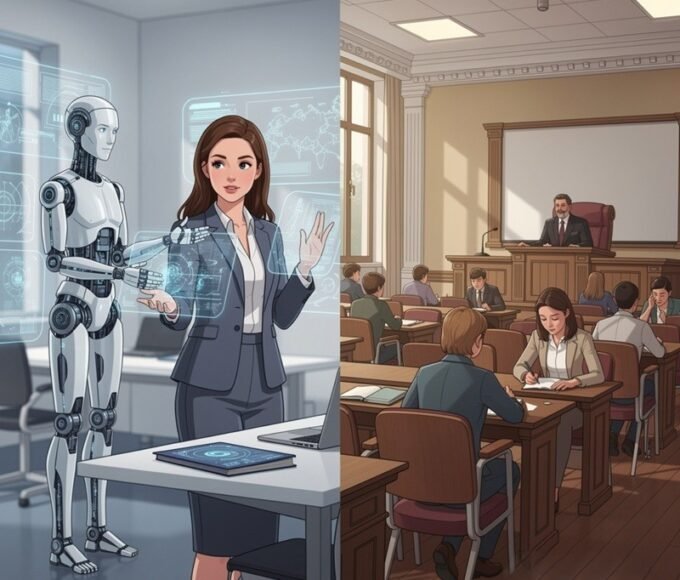
Rather than replacing professors, AI is more likely to handle routine instruction while educators focus on mentorship, discussion, and critical thinking.
Degrees May Become More Modular
The traditional four-year degree has remained largely unchanged for generations.
But employers are beginning to prioritize demonstrated skills alongside academic credentials.
As a result, online universities are experimenting with more flexible educational pathways.
Instead of completing a single long program before entering the workforce, students may earn:
- Professional certificates
- Industry-recognized microcredentials
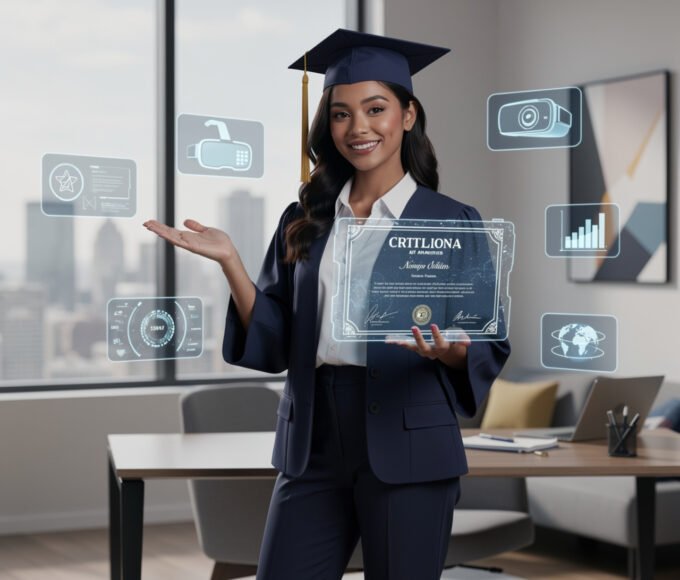
- Stackable credentials that build toward a degree
- Specialized career badges
- Short-term certification programs
This approach allows learners to gain employable skills much sooner while continuing their education over time.
For working professionals, it also makes lifelong learning far more practical.
The Classroom Will Become More Interactive
One criticism of online education has always been isolation.
Watching recorded lectures alone isn’t the same as participating in a classroom discussion.
Future online universities are investing in technologies that make digital learning more collaborative.
Students may increasingly participate in:
- Live problem-solving workshops
- Interactive simulations
- Small-group discussions
- Virtual laboratories
- Collaborative research projects
- Peer mentoring sessions
The goal isn’t simply to digitize education—it is to recreate meaningful academic interaction regardless of physical location.
Virtual Reality Could Redefine Remote Education
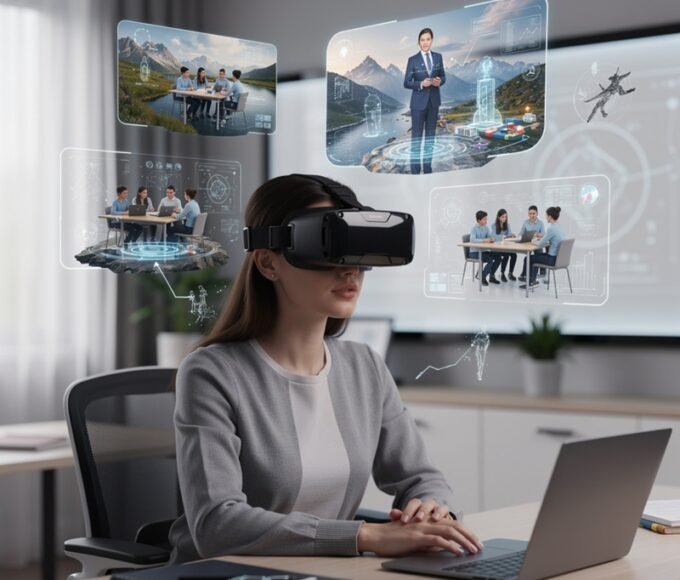
Virtual reality has the potential to solve one of online education’s biggest weaknesses: immersion.
Instead of viewing a biology lesson through slides, students might explore a three-dimensional model of the human body.
Engineering students could assemble virtual machines.
History classes could walk through reconstructed ancient cities.
Medical students could practice procedures repeatedly in realistic simulations before working with real patients.
Although widespread adoption may still take time, declining hardware costs are making immersive learning increasingly accessible.
Rather than replacing campuses, virtual reality may bring some of the campus experience directly into students’ homes.
Global Classrooms Will Become Common
One of the greatest advantages of online education is that geography matters far less.
A student in Texas can work alongside classmates in Brazil, India, Germany, or South Africa without leaving home.
This global perspective offers significant benefits.
Students gain exposure to:
- Different cultures
- Diverse viewpoints
- International teamwork
- Global business practices
As companies become increasingly international, these experiences may become just as valuable as technical knowledge.
Universities capable of building truly global classrooms could distinguish themselves in an increasingly competitive market.
Employers Will Shape More Curricula
Traditionally, universities decided what students needed to learn.
Increasingly, employers are becoming active participants in that conversation.
Many industries evolve so quickly that academic programs struggle to keep pace.
Technology, cybersecurity, artificial intelligence, renewable energy, and digital marketing are just a few examples where workforce demands change rapidly.
Future online universities are likely to collaborate more closely with employers by:
- Updating courses more frequently
- Incorporating real-world projects
- Offering internship partnerships
- Teaching current industry tools
- Developing career-focused programs
This closer connection may help reduce the gap between graduation and employment.
Assessment Will Continue to Evolve
Examinations are already changing.
As AI tools become capable of generating essays, solving mathematical problems, and writing computer code, traditional assessments become less effective.
Instead of relying heavily on timed exams, universities may emphasize:
- Portfolio-based evaluation
- Research projects
- Case studies
- Oral presentations
- Collaborative assignments
- Practical demonstrations
These methods often provide a more accurate picture of what students actually know and can do.
Student Support Will Become a Competitive Advantage
Online education is no longer judged solely by course quality.
Students increasingly expect comprehensive support throughout their academic journey.
Leading institutions are investing in:
- AI-powered tutoring
- Mental health services
- Career coaching
- Academic advising
- Peer communities
- Networking events
- Internship placement
The universities that provide strong support systems are likely to retain more students and improve graduation rates.
Challenges Still Remain
Despite rapid progress, online universities face important obstacles.
Maintaining Academic Quality
As programs expand, institutions must ensure that educational standards remain rigorous.
Reputation will continue to depend on quality rather than enrollment numbers.
Closing the Digital Divide
Reliable internet access and modern technology are still unavailable to some students.
Expanding access remains essential if online education is to become more equitable.
Balancing Technology With Human Interaction
Technology can improve learning, but relationships remain central to education.
Students still benefit from:
- Mentorship
- Discussion
- Feedback
- Community
- Shared experiences
The most successful online universities will likely combine advanced technology with meaningful human support.
What Students Should Expect Over the Next Decade
The online university experience of 2035 may look very different from today’s.
Students may:
- Learn with AI tutors available 24/7
- Attend immersive virtual classrooms
- Build degrees through stackable credentials
- Collaborate with classmates around the world
- Complete more project-based assessments
- Receive personalized career guidance throughout their studies
Rather than replacing traditional universities, online institutions are likely to become increasingly sophisticated alternatives that appeal to a broader range of learners.
The Future Is Less About Location Than Opportunity
The debate over whether online education is “better” than traditional education is gradually becoming less relevant.
A more important question is whether a university prepares students for a rapidly changing world.
The institutions that succeed won’t necessarily be those with the largest campuses or the oldest traditions. They’ll be the ones that combine academic excellence with flexibility, technology, and strong connections to the modern workforce.
For students, this is good news.
Higher education is becoming more accessible, more personalized, and more adaptable than ever before.
The university of the future may not be defined by the buildings it owns, but by the opportunities it creates—wherever its students happen to be.


Leave a comment