
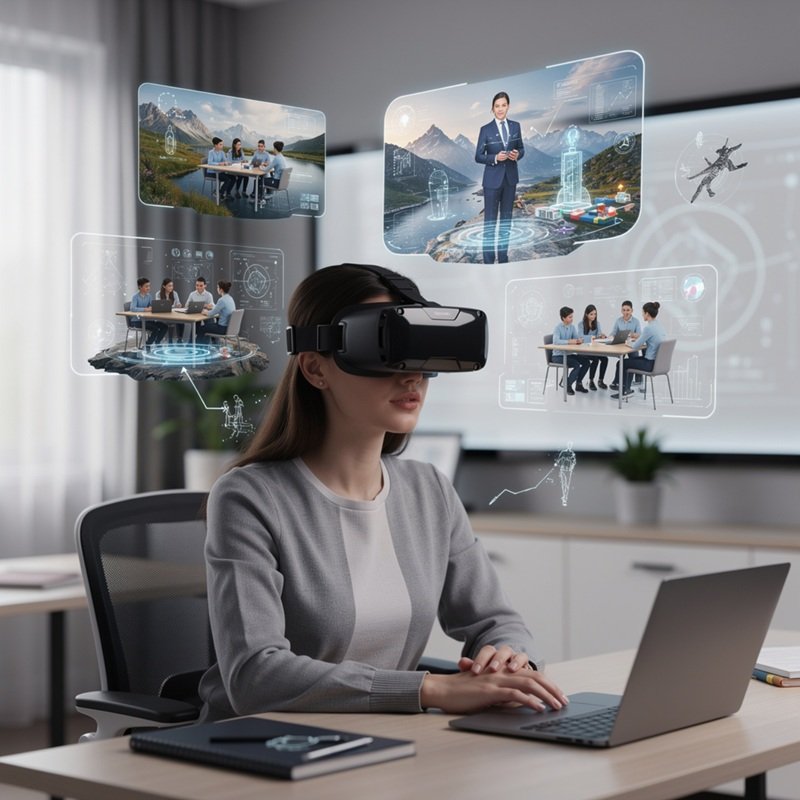
For decades, distance learning has been defined by one simple idea: bringing education to students wherever they are. The internet made it possible to attend classes without commuting, earn degrees from prestigious universities across the country, and balance education with work or family responsibilities.
But despite all its advantages, online learning has always had one obvious limitation—it often feels distant.
Watching lectures through a laptop screen is convenient, but it rarely captures the energy of sitting in a classroom, raising your hand during a discussion, collaborating with classmates, or participating in a laboratory experiment. Even the best video conferencing platforms struggle to recreate the sense of being present.
Virtual reality (VR) is beginning to change that.
Once considered a niche technology associated mostly with gaming, VR is now becoming a serious tool in education. Universities, technology companies, and corporate training programs are investing heavily in immersive learning environments that allow students to step inside digital classrooms rather than simply watching them from a screen.
While widespread adoption is still in its early stages, virtual reality has the potential to become one of the most significant developments in online education since the rise of high-speed internet.
The Evolution of Online Learning
Distance education has come a long way in a relatively short time.
The earliest online courses relied heavily on downloadable documents, discussion boards, and email communication. Over time, improvements in internet speeds introduced live lectures, cloud-based collaboration, recorded classes, and interactive learning platforms.
Each technological leap made online education more accessible.
What none of these innovations fully solved, however, was engagement.
Educators have long recognized that students tend to learn more effectively when they actively participate rather than simply consume information. Reading, watching videos, and listening to lectures all have value, but they often place students in a passive role.
Virtual reality shifts that dynamic by turning learners into participants.
Instead of observing a lesson, students experience it.
Learning Through Presence
One of VR’s greatest strengths is something researchers refer to as “presence”—the feeling of actually being inside an environment rather than merely looking at it.
This changes the educational experience in subtle but important ways.
Imagine attending an architecture class where you can walk through a building before it’s constructed. Or studying marine biology by exploring a coral reef without leaving your home.
History students could stand inside a recreation of ancient Athens.
Engineering students could inspect the inner workings of a jet engine from every angle.
Medical students could practice emergency procedures in realistic hospital simulations.
These aren’t just visual demonstrations. They’re interactive experiences that encourage exploration, experimentation, and curiosity.
For many learners, that level of immersion makes difficult concepts easier to understand and remember.
Subjects That Stand to Benefit the Most
Virtual reality won’t transform every discipline equally.
Reading literature, analyzing historical documents, or writing essays may not require immersive environments. A well-designed online platform can already support those activities effectively.
Other subjects, however, are uniquely suited to VR.
Healthcare
Medical education increasingly relies on simulation.
Virtual reality allows students to practice surgeries, diagnose virtual patients, and rehearse emergency situations repeatedly without risk.
Mistakes become learning opportunities rather than dangerous outcomes.
Engineering and Manufacturing
Engineering students often need access to expensive laboratories and equipment.
VR enables them to:
- Assemble mechanical systems
- Test prototypes
- Explore industrial facilities
- Simulate manufacturing processes
- Visualize complex structures
These experiences reduce costs while increasing opportunities for practice.
Science Education
Chemistry, biology, astronomy, and physics all involve concepts that are difficult to visualize using textbooks alone.
Virtual reality can transform microscopic cells, molecular interactions, or planetary systems into environments students can explore firsthand.
Skilled Trades
Training electricians, mechanics, construction professionals, or aviation technicians often requires hands-on experience.
VR cannot completely replace physical practice, but it allows learners to safely develop procedural skills before working with real equipment.
Collaboration Feels Different in Virtual Spaces
One of the biggest criticisms of online education has always been the lack of meaningful interaction.
Virtual classrooms attempt to address this by creating shared spaces where students appear as digital avatars.
Instead of speaking into a webcam, learners can:
- Gather around virtual tables.
- Work together on projects.
- Present ideas to classmates.
- Visit digital laboratories.
- Participate in group discussions.
The experience feels less like joining a video call and more like entering a classroom.
This sense of shared presence can improve participation, particularly for students who feel disconnected in traditional online courses.
Artificial Intelligence Could Make VR Even Smarter
Virtual reality becomes even more powerful when combined with artificial intelligence.
Imagine a classroom where an AI teaching assistant notices you’re struggling with a concept before your instructor does.
It could:
- Offer additional explanations.
- Adjust lesson difficulty.
- Generate personalized exercises.
- Recommend review materials.
- Track your progress over time.
Meanwhile, another student who has already mastered the material moves forward without waiting for the rest of the class.
This combination of immersion and personalization has the potential to reshape online education in ways that traditional classrooms often cannot.
The Cost Barrier Is Falling
For years, VR adoption was limited by expensive hardware.
That reality is changing.
Modern headsets have become:
- More affordable
- Lighter
- Wireless
- Easier to use
- More comfortable during longer sessions
At the same time, software developers are building educational applications specifically designed for universities and training institutions.
Although costs remain higher than traditional laptops, the gap continues to narrow each year.
As prices decrease, broader adoption becomes increasingly realistic.
Challenges That Still Need Solutions
Despite its promise, virtual reality is far from becoming the default learning environment.
Several obstacles remain.
Accessibility
Not every student has access to:
- High-speed internet
- VR hardware
- Adequate physical space
Universities must ensure technological innovation doesn’t create new barriers to education.
Motion Sickness
Some users experience discomfort during extended VR sessions.
Although hardware improvements have reduced this issue considerably, it’s still an important consideration for educators designing immersive lessons.
Faculty Training
Technology alone doesn’t improve education.
Professors need training to understand when virtual reality genuinely enhances learning—and when simpler teaching methods remain more effective.
Poorly designed VR lessons can become distractions rather than educational tools.
Beyond the Classroom
Virtual reality’s value extends beyond formal instruction.
Students could use VR to:
- Attend virtual career fairs.
- Participate in networking events.
- Visit international universities.
- Practice public speaking.
- Conduct collaborative research.
- Explore cultural landmarks connected to their coursework.
These experiences help recreate some aspects of campus life that many online students currently miss.
Is VR the Future of Distance Learning?
Probably—but not in the way many people imagine.
Virtual reality is unlikely to replace every lecture, every assignment, or every discussion.
Instead, it will probably become another tool available to educators.
A biology professor might combine traditional lectures with virtual laboratory sessions.
An architecture course might alternate between design software and immersive building walkthroughs.
A medical program may use VR simulations alongside in-person clinical training.
Rather than replacing existing methods, virtual reality is likely to expand what’s possible.
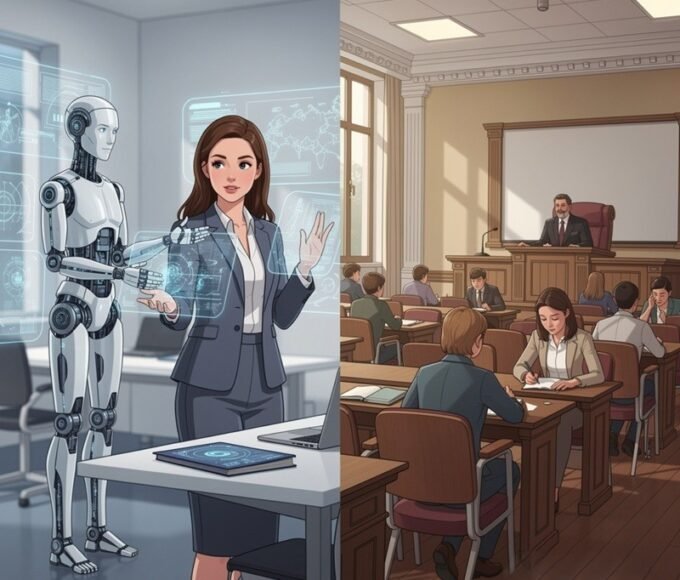
The Classroom Is Becoming a Place, Not a Location
Perhaps the biggest shift isn’t technological at all.
For centuries, classrooms were defined by buildings.
Distance learning changed that by making education independent of geography.
Virtual reality takes the idea one step further.
Instead of asking students to travel to a campus, it brings the classroom experience to wherever they happen to be.
That distinction matters.
The future of education may no longer depend on where learning takes place, but on how effectively technology creates meaningful experiences that help students understand, apply, and retain knowledge.
For online universities, this represents more than an upgrade in software.
It represents a fundamental rethinking of what a classroom can be.
And as virtual reality continues to mature, the distance in “distance learning” may become less noticeable than ever before.





Leave a comment